

Professional Protest Culture
The NGO Machine: How Paid Activists Scale Radical Protests Across America

INVESTIGATIONS: By Walter Curt
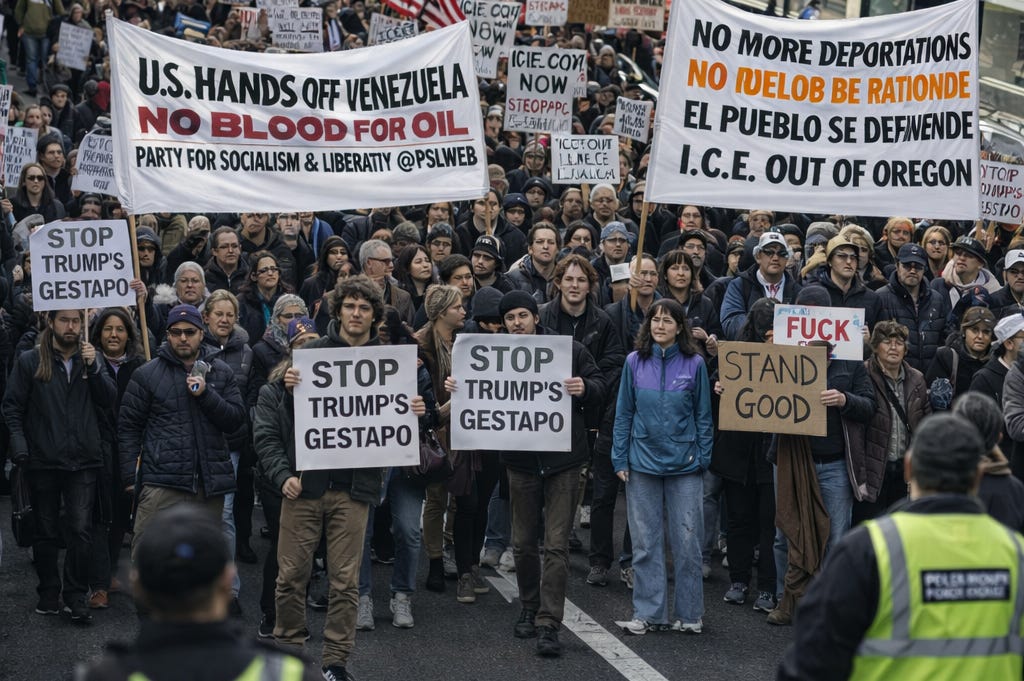
You’ve seen it. A breaking-news moment hits the feed and, like clockwork, the street show materializes fully assembled. Not just bodies, but branding. Not just emotion, but execution. Matching placards, matching chants, matching hashtags, legal observers on the perimeter, “marshals” in neon vests, a sound system that didn’t fall off the back of a truck by accident, and spokespeople who know exactly which camera to talk to. The same activists popping up in different cities, different weeks, different “spontaneous” causes, always on time, always equipped, always ready. How? Who’s paying for the mileage, the hotel nights, the printed materials, the staff time? Are we supposed to believe this is organic civic engagement, random storms that always organize themselves into a parade?
Of course it isn’t, and our latest report ends that myth permanently.
The easiest way to dismantle the myth that protests aren’t funded isn’t rhetorical—it’s mathematical. The nonprofit sector is not a side hobby. The Bureau of Labor Statistics’ nonprofit research data shows roughly 12.8 million jobs in 501(c)(3) nonprofits in 2022—about 9.9% of all private-sector employment. One in ten private-sector jobs sits inside a tax-exempt structure. The Urban Institute has documented how measurable, durable, and economically significant nonprofit employment is, it’s a tracked workforce. If you can’t see how a labor pool that large can be leveraged politically, you’re simply being disingenuous.
The predictable response is: ‘Most nonprofit workers aren’t activists.’ That’s correct—and irrelevant. Most doesn’t mean all.
“A plausible estimate is that progressive advocacy NGOs employ several hundred thousand people nationally. Even the largest advocacy nonprofits (ACLU, Planned Parenthood, major environmental groups, labor unions) combined might total in the low hundreds of thousands of staff…..Thus, a rough ballpark for “progressive movement professionals” (people whose day job is organizing for progressive causes) might be on the order of 500,000–1,000,000.”
NGO Workforce and Left-Wing Protest Mobilization in the United States (2010–Present) — The W.C. Dispatch 2026
Advocacy-adjacent employment sits inside categories like “other services” and “public/societal benefit,” and even conservative estimates put the advocacy slice in the high six figures to low seven figures nationally when you consider staff in advocacy organizations, allied nonprofits, and the union apparatus that functions like a political machine in a different legal wrapper.
You do not need millions of paid protesters to generate mass turnout. Hundreds of thousands of paid organizers and institutional staff, embedded inside permanent nonprofit and union structures, are more than sufficient to activate networks on demand.
The argument collapses the moment people get stuck on whether protesters are handed cash like day laborers. That isn’t how modern activism works. The real leverage sits one layer up: pay the organizers, not the crowd. Fund the staff, not the sign-holder. Build the lists, the toolkits, the coalitions, the legal defense, the media operation—and when the moment hits, the crowd assembles on its own because the machinery is already in place to direct it. Fixating on the bodies misses the point. The power lives in the infrastructure. Infrastructure is the force multiplier. It turns a viral moment into a national operation, keeps movements alive after the cameras leave, and explains why the same protest operations reappear, city after city, cause after cause, without ever starting from zero.
Once you see that infrastructure is the power center, the scale question stops being rhetorical and becomes measurable. We have already shown that there are, at a minimum, more than 500,000 people working full-time inside activist NGOs and advocacy organizations alone. And that’s before counting union organizers or the semi-professional movement staff who function as organizers in everything but title. That is a standing operational workforce, not a protest anomaly. The only remaining question is whether that infrastructure is sufficient to generate the turnout levels we keep seeing, and that is not an ideological question. It is a numerical one.
To solve for this question, we built a simple mobilization model to test plausibility: (T = N × m × r) Where total turnout (T) equals the size of the activist base (N), multiplied by the mobilization rate (m), multiplied by the recruitment multiplier (r).
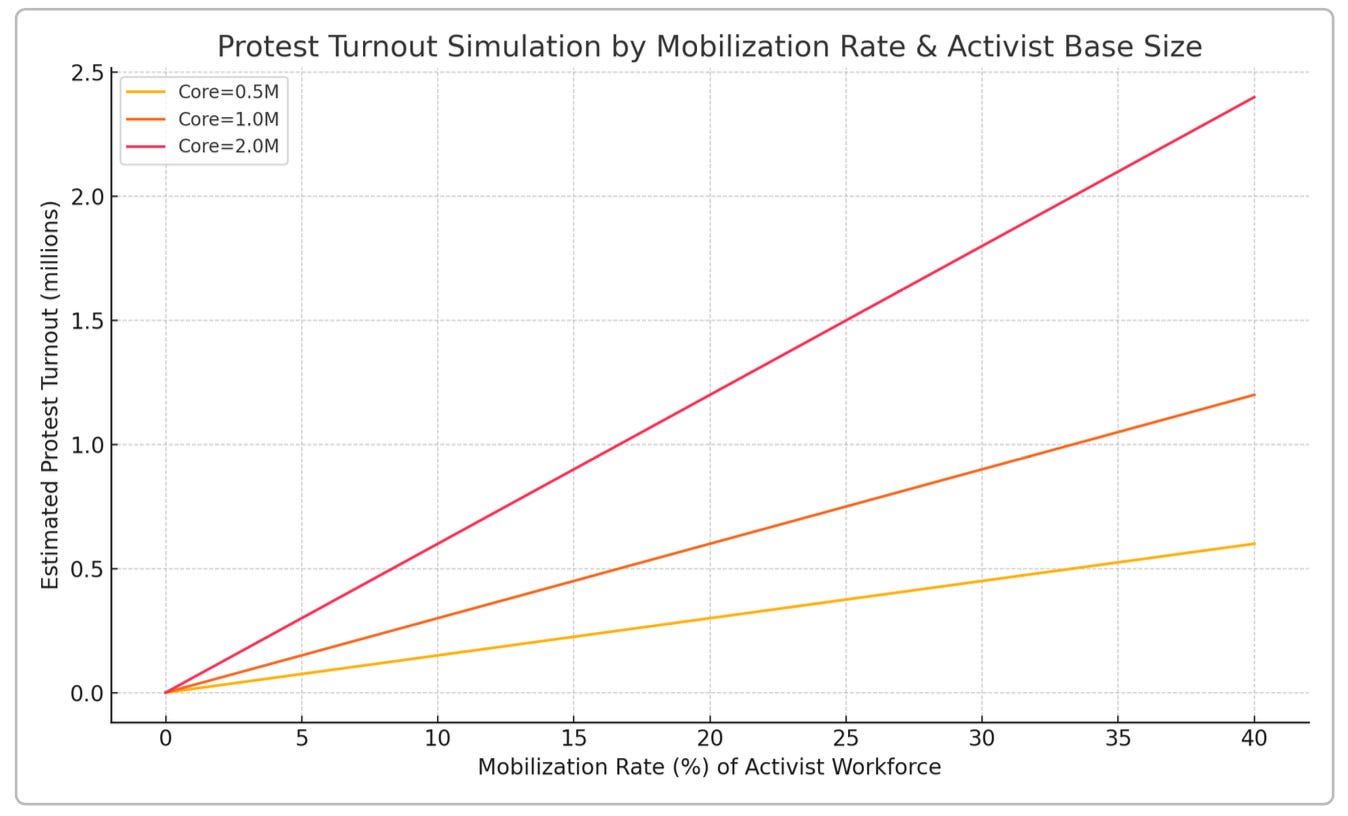
Turnout is not mysterious. It follows a simple relationship. The number of people who show up depends on three things: how large the activist workforce is, how much of it is activated, and how effectively those organizers can pull in others. That is the entire model. A standing activist base activates a fraction of its people, and each of those people brings more bodies with them through lists, networks, workplaces, campuses, churches, and social media.
When you plug in conservative assumptions, the numbers line up quickly. With an activist base of roughly one million people, activating just 20 percent and assuming each organizer pulls in two additional participants produces a crowd of about 600,000. Expand that base to two million and activate 30 percent, and you are already near 1.8 million participants. During moments of intense public outrage—when recruiting becomes easier and resistance drops—the totals rise even faster.
That is what a force multiplier looks like in practice. You do not need most of the country on a payroll to flood the streets. You need a disciplined core, embedded in real institutions, capable of activating networks and amplifying momentum.
Case Studies
The usefulness of the model rests on a simple test: does it describe what actually happened? When you apply it to the largest protest mobilizations of the last decade, the answer is yes. The turnout levels we observed are not outliers or miracles. They fall squarely within the range you would expect from a standing activist infrastructure activating at varying levels under different conditions.
Start with the 2017 Women’s March. An estimated 3.3 to 5.3 million people participated nationwide, anchored by Washington, D.C., but executed through hundreds of synchronized sister marches. That scale fits exactly what the model predicts from a large activist base mobilized at moderate intensity. You do not need millions of paid protesters to produce that outcome. You need a professional core—organizers, communications staff, legal teams, coalition partners—capable of activating networks across hundreds of cities simultaneously. Organizations like Planned Parenthood, with national affiliates and permanent staff, provided that capacity. The result was mass turnout generated through partial mobilization and modest recruitment, without centralized command.
The 2020 George Floyd protests fit the same model under different parameters. Harvard researchers estimate 15 to 26 million Americans participated over time, making it the largest protest movement in U.S. history. That number looks extraordinary until you adjust the inputs. In 2020, the activist base was already built, but the mobilization rate and recruitment multiplier both spiked. Public outrage reduced friction. Recruitment accelerated. Networks that normally bring in two or three additional participants suddenly brought in far more. No credible claim suggests a single organization controlled that turnout, and none is required. What mattered was the existing ecosystem—chapters, coalitions, donor pipelines, legal support, media operations—ready to activate immediately. The Black Lives Matter Global Network Foundation and aligned nonprofits formed part of that scaffolding. The anger was organic. The expansion followed the math.
In both cases, the same pattern holds. Change the conditions, change the parameters, and the outcomes scale accordingly. The model does not claim protests are fabricated. It explains how they become massive. A disciplined activist core activates. Networks amplify. Infrastructure converts emotion into turnout. What looks chaotic from the outside is, in fact, highly predictable once you account for the machinery underneath.
The math does not stretch to fit the events. The events fall exactly where the math says they should.
The Accountability Gap
And this is where the real problem comes into focus. What happens when a disciplined, professional activist class operates inside tax-exempt institutions with minimal public accountability? What happens when shaping public pressure becomes a salaried occupation? The answer is not theoretical. When activism becomes an employment sector, protest becomes a political weapon with asymmetric advantages. It can flood the zone, set narratives, intimidate local officials, and pressure private institutions by manufacturing the appearance of ubiquitous consensus—identical slogans, identical optics, identical talking points—replicated across hundreds of communities at once. Our modeling does not just explain that this is possible. It demonstrates that it is effective.
This is not about denying free speech or pretending ordinary Americans are automatons. People show up because they care. But the machinery determines scale, timing, and direction. The report shows nonprofit employment is heavily concentrated in political and media hubs, meaning the people closest to institutional power are often embedded inside the deepest activist infrastructure. That concentration matters. It means a relatively small professional class can distort perceived public opinion far beyond its actual size. Not a conspiracy. A system. Built over decades. Staffed by professionals. Fueled by tax-advantaged money. Activated on demand.
The danger is not protest itself. The danger is opacity. A political ecosystem where paid organizers, shielded by nonprofit status, can shape national narratives while avoiding the scrutiny applied to campaigns, parties, or corporations. The modeling proves the leverage. The case studies prove the execution. Together, they force an uncomfortable conclusion: modern protest culture is no longer merely grassroots expression—it is a managed, professionalized pressure industry.
If accountability matters, this is where it begins. Not by arguing about whether an individual marcher was paid, but by tracing the full supply chain—from tax-exempt funding and NGO payrolls to permits, transportation, training, media coordination, and legal defense. That operational layer is the missing picture. Until it is examined honestly, the nonprofit-industrial complex will continue to function as a parallel political machine—one capable of scaling pressure, shaping perception, and distorting democratic signals while remaining largely out of view.
